ATV
repeater F5ZFI

Place of
installation: Nimes in the residence of F5AD
in the west of the city
Administrative
person in charge F5AD
Take part in its
operation: F1FCO, F5AD, F6BES and F6DBU
Video
sources:
- Input 10 385
MHz vertical polarization from Marseilles
- Input 2320
MHz horizontal polarization from the east of the town of
Nimes
- Local test
card with call sign
Emission
1255 MHz:
- Frequency
1255 MHz
- Soun sub
carrier on 6,5MHz
- Power 1,6 W
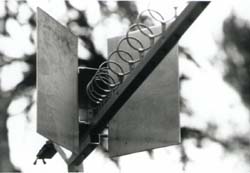
- Antenna:
quadruples quad in front of areflector
- Horizontal
polarization
- Direction
centre town of Nimes

Reception
10 GHz:
- Antenna:
offset parabola 60 cm head above to receive with
horizontal (see photo)
- Satellite
head modified by F1FCO
- Satellite
receiver modified to always start on the good channel
Reception
2320 MHz:
- Antenna: 23
elements quad with horn source (as with Tonna)
- The quad
elements make the antenna less sensitive to the rain than
with Yagi elements
- Standard
converter Arabsat at the antenna
- Satellite
receiver modified to always start on the good channel
Remote
controls:
- This repeater
is currently semi-automatic
- The startup
is done by remote control DTMF on 144,575 M
 Hz, the code is #5AD
- It detects
then the possible presence of an ATV signal on one of its
inputs and returns it on 1255 MHz towards the town of
Nimes
- The detection
of the 2320 has priority in front of that of the 10 GHz
- If there are
neither 2320 nor 10 GHz signals atthe antennas, the 1255
GHZ is modulated by the test card.
- Emission 1255
is stopped by a marking time at the end of thirty
minutes, it is necessary to start again by #5AD
- One can stop
the transmission before the end of marking time by
command DTMF #5A0
Uses:
- This repeater
is one of the nodes of the network and allows the
Marseilles connection towards Nimes: any emission coming
from Marseille node F5ZAJ on 10 GHz is
retransmitted on Nimes on 1255
- In parallel,
the stations badly released in Nimes in the axis of the
2320 antenna can be retransmitted on 1255.
Projects:
- The remote
control will be modified in the future; automatic
detection will be removed because it causes video Larsens
in certain configurations. the system of remote control
will be then in conformity with that of the network
- The frequency
of the remote control will remain 144,575 MHz
- DTMF codes
will start with #5 (four codes in all)
- A " Web
camera " will be installed on the pylon, it will
film the antennas
- 10220 MHz
connection towards F5ZEI (6BES), currently
manual, will be automated in order to transmit the
signals towards F5ZGN (Aigoual mount)
Ways,
frequencies, adjacent nodes, polarizations
in the
final network
| Site 5 (F5AD) |
| F5ZFI |
| Transmitter |
Receiver |
| Code |
Fréq. |
Dest. |
Pol. |
Code |
Freq. |
Orig. |
Pol. |
| With |
1255 |
Users |
H |
2 |
2320 |
Users |
H |
| B |
2420 |
Users |
H |
3 |
10385 |
F5ZAJ |
V |
| C |
2320 |
F1ZGM |
H |
4 |
10400 |
Lure |
V |
| D |
10220 |
F5ZEI |
V |
6 |
2320 |
F5ZEI |
H |
| |
|
|
|
|
|
|
|
| |
|
|
|
|
|
|
|
| |
|
|
|
8 |
|
Webcam |
|
| |
|
|
|
9 |
|
Call sign |
|
Possible commands in the final
version: #Ä2 #Ä3 #Ä4 #Ä6 #Ä8 #Ä9 #5B2 #5B3 #5B4 #5B6 #5B8
#5B9 #5C2 #5C3 #5C4 #5C6 #5C8 #5C9 #5D2 #5D3 #5D4 #5D6 #5D8 #5D9
Reference on the
10 GHz
Return to the welcome page
©
1999-2011 A. Ducros F5AD